Mud Season
Anyone who has ever tried to hide something by putting more on top of it knows this. Paint over a damaged wall and the cracks show through worse than before. Hang a door on a crooked frame and every gap announces itself.

I should confess something. Every winter, somewhere around February, I start wearing more sweaters. And vests. Sometimes both. I tell myself it's because I'm cold. This is not entirely the reason. The truth is that winter adds a few pounds and I would rather not think about it, so I add a layer. One more covering between me and the honest truth about what's underneath.
It never works, of course. Anyone who has ever tried to hide something by putting more on top of it knows this. Paint over a damaged wall and the cracks show through worse than before. Hang a door on a crooked frame and every gap announces itself. The covering doesn't solve the problem. It just gives it one more thing to push through.
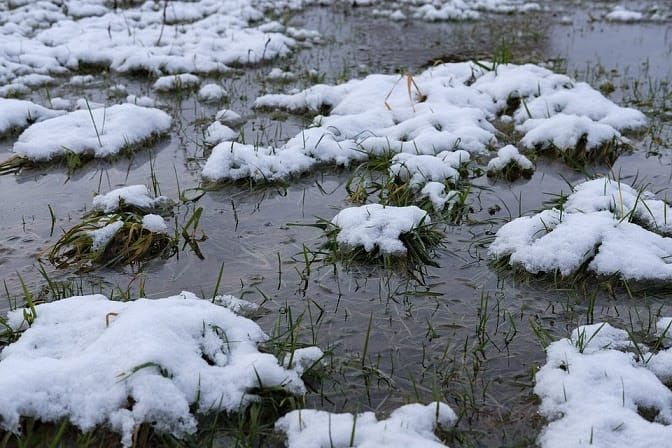
We got over a foot of snow this week. It was, for about an hour, stunning — the pond path buried in white, every branch holding its clean, quiet line. Fresh snow has a way of making you think everything has been made new. But it hadn't. Underneath the new snow were the old mounds, the compacted ice, the gray piles from the last storm and the storm before that. The fresh layer just made the old shapes taller and stranger, like a fitted sheet over furniture in a house nobody's lived in for a while.
And then I stepped off the path. And the mud came up.
Right through the snow. Dark, honest, unstoppable — rising through the white to meet my boot. Twelve inches of fresh cover, and the ground remembered exactly what was underneath. It could not be hidden. It came through anyway.
I think this is what Lent is for. Not the adding of layers — not more discipline piled on top of the same unexamined life, not new resolutions covering old patterns. Lent is the season that says: stop covering over. Remember that you are dust. And dust becomes mud. Let the thaw come. Let what's underneath come through.
This is not comfortable. The mud is not pretty. Last week we talked about the wilderness and the temptation to force the landscape to perform for us. This week the landscape is performing, but not the way we'd choose. The mud is honest in a way the snow was not. It shows us what the ground has been holding all winter — the mess, the rot, the saturated earth that has been doing its slow, necessary work in the dark.
And here is the thing we forget: mud is full of life. Every gardener knows this. The clean, white, photogenic snow grows nothing. The mud — that dark, exposed, embarrassing mess we'd rather cover — is where life actually begins. The pond's edge is ugliest right now, and it is also doing its most important work.
God doesn’t ask us to be clean. God asks us to stop pretending we already are. And then, gently, shows us that the place we were most ashamed of is the place where new life has been growing all along.
If you've tried to walk in the snow this week, you already know this theological lesson. Your shoes know it too.
A Prayer:
God of the thaw and the honest ground, you do not ask us to be spotless — you ask us to be real. When we would add another layer rather than face what lies beneath, give us the courage to step off the path and let the mud come through. Teach us that the mess we have been hiding is not our failure but your soil — the dark, necessary ground where you have been planting things all winter. Through Christ, who knelt in the dirt of a garden the night before he died, and was not ashamed of the earth. Amen.